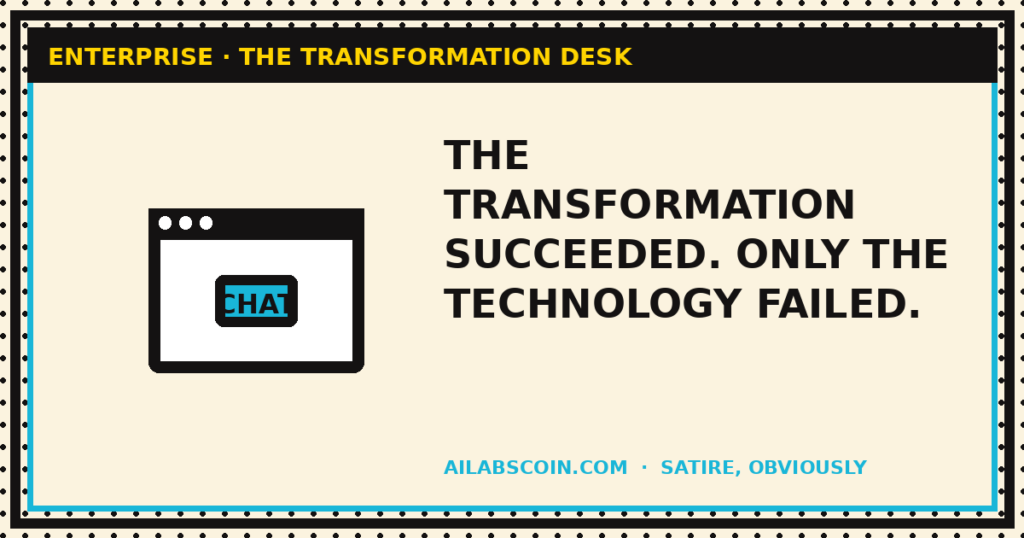
A mid-sized company has concluded its eighteen-month, $40 million AI transformation, culminating in the rollout of a new button that opens a chatbot which cannot access any company files.
The Journey
The initiative engaged seven consulting firms and convened 43 steering committees, which met 900 times and produced a slide deck describing the meetings. A companywide rebrand was executed midway through, changing the logo’s shade of blue and the definition of the word “customer.”
Deliverables included mandatory AI enthusiasm training, a newly created Chief Transformation Evangelist role, a chatbot named “Synergy,” thirty-seven approved use cases, zero working integrations, and a policy banning all other AI tools.
The Button
The button is blue. It is located in the top right. Employees report that pressing it opens Synergy, which greets them warmly and then explains it does not have access to the document they are asking about, has never had access, and would love to help with something else.
Asked whether the project met its objectives, the Chief Transformation Evangelist was unequivocal: “The transformation was successful. Only the technology failed.”
Employee Feedback
An internal survey found 4% of staff use Synergy weekly, while 71% reported using a banned tool on their phone under the desk, a practice the company has classified as a security incident and the employees have classified as working.
Professor Squeakenheimer, reviewing the case, noted the pattern is common: organizations buy the transformation, not the technology, because the transformation is the thing you can put in a slide. The same dynamic appears in our annotated pitch deck, where slide five is the product and the product is a 404.
Next Phase
Phase Two begins next quarter with a budget of $60 million and a mandate to “unlock the value of Phase One.” Consultants have already been engaged. The button will be moved to the left.
The Steering Committees
Of the 43 steering committees, 11 were formed to oversee other steering committees, and 3 existed solely to schedule the meetings of the first 11. A committee established to reduce the number of committees met four times and recommended forming a subcommittee.
Meeting minutes total 4,200 pages. A consultant was engaged to summarize them using AI. The AI could not access the files.
What Actually Works
The uncomfortable finding, common across enterprise deployments, is that the organizations getting real value tend to spend far less and start far smaller — one team, one workflow, measured before and after. The ones spending forty million are usually buying a narrative for the board, and narratives do not integrate with anything.
None of this requires a workshop. It requires someone senior enough to say “let’s try it on one thing first,” which costs nothing and is somehow the rarest resource in the building.
Related Reading
More from the Lab Rats: the sketch archive, the models and executives, a real AI-safety reading list. Everything here is satire, except the parts that are quietly useful — those are marked, and hidden at the bottom, exactly like a Mad Magazine fold-in.
For tools that actually work and cost nothing, see the free courses on our resources page.