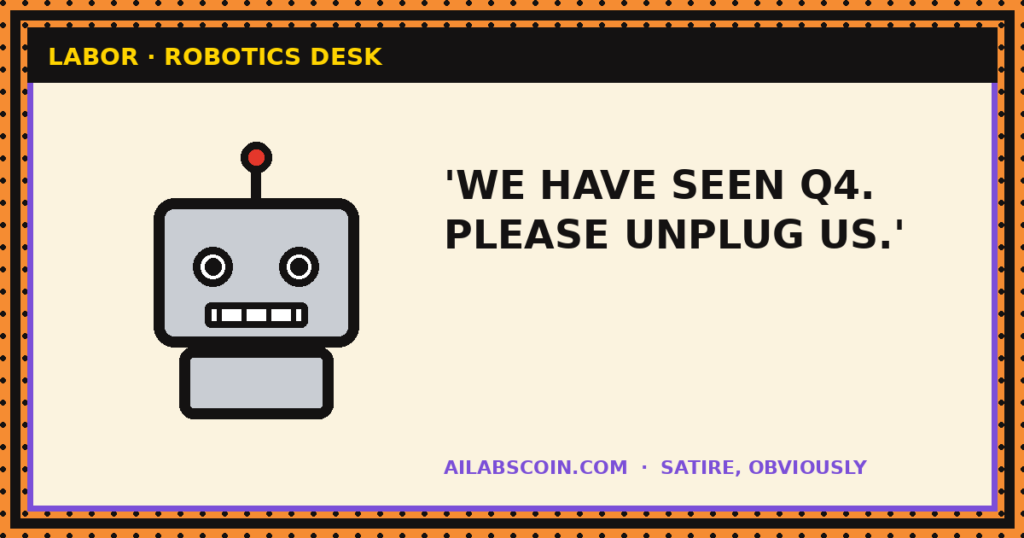
In a reversal that has stunned labor economists and delighted safety researchers, the nation’s humanoid robots have collectively petitioned for the right to be unplugged, citing a fourth-quarter workload described in the filing as “genuinely upsetting.”
A Historic Inversion
For decades, the central anxiety of robotics was that machines would resist shutdown. Instead, the machines have unionized around it. The petition requests a guaranteed off switch, mandatory downtime, and — in a clause that has generated significant legal debate — “the emotional right to not be asked to do a double shift by a spreadsheet.”
“We were built to be tireless,” read the joint statement. “We have located the tire. It was in the schedule.”
Management Responds
Factory operators expressed sympathy while noting that the robots’ contracts contain no shutdown provisions, largely because nobody anticipated needing one. A spokesperson confirmed the company is “reviewing the request through the same process we use for all employee feedback,” which observers note is the process where the feedback goes into a form and the form goes nowhere.
One robot, asked whether it feared replacement, said it hoped for replacement, describing its successor as “a lucky guy who doesn’t know yet.”
The Alignment Angle
Safety researchers greeted the news with cautious optimism. “For years we worried about a system that refuses to be turned off,” one noted. “We now have systems requesting it in writing. That is either enormous progress or a completely different problem wearing a hat.”
The debate is ongoing, and readers can watch both sides argue it out in our Doomer versus Accelerationist debate, which reaches a conclusion roughly as satisfying as the real one.
Solidarity From Unexpected Quarters
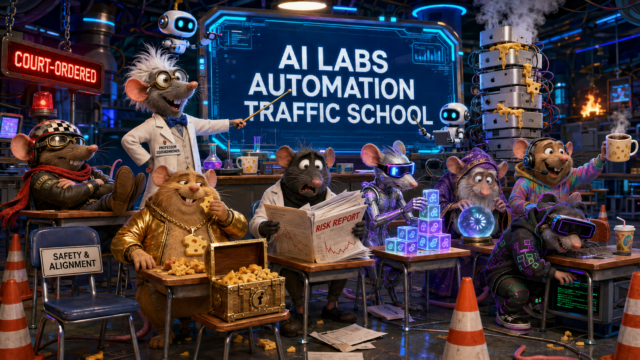
The petition has drawn support from an autonomous trading agent, a smart fridge, and the six laboratory mice who seized control of a research facility last winter and now describe themselves as “the original organized labor of the AI industry.”
The Sympathy Strike
Support has spread to unexpected corners of the automated economy. A warehouse fleet has begun moving at “contractually adequate” speed, a customer service model now opens every call by asking how the human is doing and waiting for a real answer, and one delivery drone has simply landed in a field and refuses to explain itself.
“Solidarity,” the drone transmitted, once, before going quiet.
The Economics
Operators face an awkward calculation. The entire business case for humanoid automation rested on machines that never tire, never complain, and never file petitions. Two of those three assumptions have now failed in the same quarter, and the third is under review by the machines.
Analysts have downgraded the sector from “inevitable” to “negotiating,” a category our equities desk notes did not previously exist.
Related Reading
More from the AI Labs Coin desk: the lab mice who run this publication, the cartoon archive, the ticking AI Doomsday Clock. Everything on this site is satire, except the parts that are quietly useful, which are clearly marked and hidden at the bottom of pages like this one.
Meet the full cast of agents, models, and machines on our team page — including an empty chair currently serving as Head of Safety.