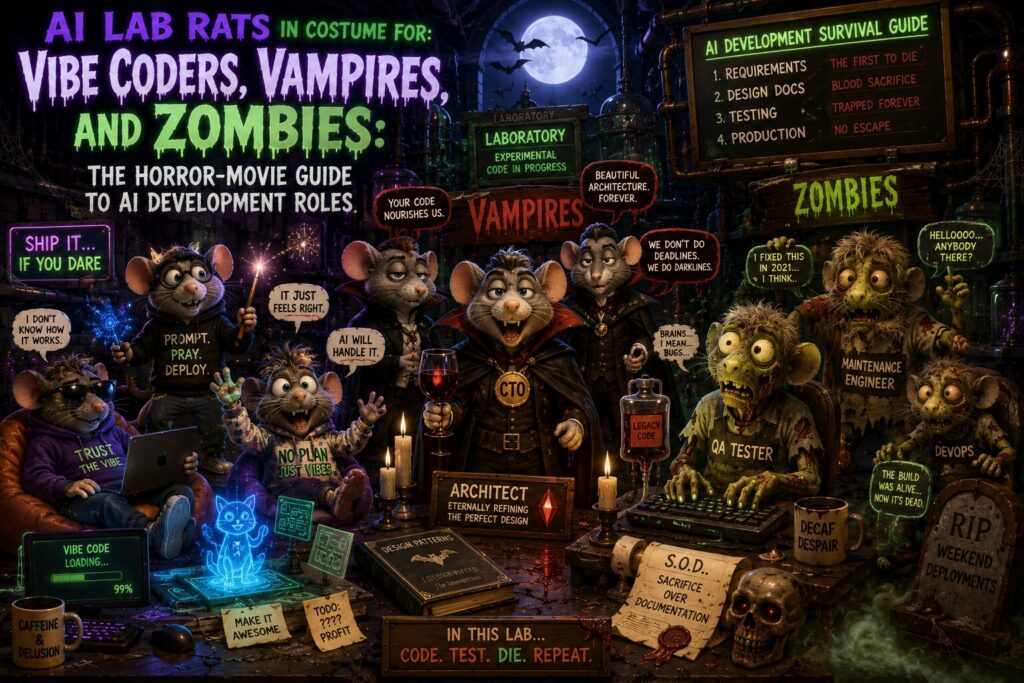
Vibe Coders, Vampires, and Zombies: The Horror-Movie Guide to AI Development Roles
Every era of software development produces its own cast of characters. The 2000s had the “10x engineer” and the “cowboy coder.” The 2010s gave us the “full-stack unicorn.” Now, in the age of AI-assisted development, a new taxonomy has emerged — and honestly, it reads less like a job board and more like a horror movie roster.
If you’ve spent any time building software with AI tools in 2026, you’ve probably already met these three archetypes. You might even be one of them.
The Vibe Coder
The pitch: Move fast, trust the model, don’t look back.
The Vibe Coder treats the AI like a collaborator with infinite patience and zero judgment about scope creep. They describe a feature in a sentence, watch code appear, run it, and if it mostly works, they ship it. Iteration happens in the prompt, not in the diff.
Their superpower: Speed. A Vibe Coder can go from idea to working prototype in the time it takes a traditional developer to set up their linter. For hackathons, throwaway scripts, and early-stage validation, this is genuinely magic.
Their curse: They rarely read the code they’re shipping. Which means when something breaks in production, they’re debugging a system they never actually understood in the first place — often by vibe-coding the fix, too.
You might be a Vibe Coder if: your commit messages are just what you typed into the chat window.
The Vampire
The pitch: Drains context windows dry, feeds on infrastructure, never seems to age.
The Vampire is the engineer who’s figured out how to extract maximum value from AI tooling without ever really “believing” in it. They’re not romantic about AI — they see it as leverage, plain and simple. They’ll happily burn through massive context windows, chain together multiple models, and build elaborate harnesses, all in service of squeezing out marginal gains.
Their superpower: Efficiency at scale. Vampires are usually the ones building the automation pipelines, the agent orchestration layers, and the infrastructure that quietly powers everything else. They understand loops, retries, and state management because they’ve been burned by all three.
Their curse: They can lose sight of the humans on the other end of the system. Optimizing the pipeline becomes the goal instead of the product it serves — and their codebases, while powerful, are sometimes so specialized that only the Vampire themselves can maintain them.
You might be a Vampire if: you have strong, specific opinions about token budgets and none about user experience.
The Zombie
The pitch: Copy. Paste. Don’t ask questions.
The Zombie is the cautionary tale. They use AI coding tools the same way they’d use Stack Overflow in 2015 — copy the output, paste it in, run it, repeat until the error goes away. There’s no review, no understanding, no mental model of what the code is actually doing. Just forward motion.
Their superpower: Honestly? Volume. Zombies can produce an enormous amount of code very quickly, and in low-stakes environments, that’s sometimes enough.
Their curse: Everything else. Zombie-built systems tend to be brittle, insecure, and nearly impossible to debug — because nobody, including the Zombie, ever understood how the pieces fit together. When something breaks, there’s no mental model to fall back on. Just more copying and pasting, hoping the next answer is the right one.
You might be a Zombie if: you’ve shipped code you couldn’t explain if someone asked you to.
So Which One Are You?
Here’s the uncomfortable truth: most developers using AI tools today are some blend of all three, depending on the day, the deadline, and how much sleep they got. The goal isn’t to fully avoid any one archetype — vibe coding has its place, efficiency-hunting is valuable, and sometimes copy-paste-and-move-on is the right call for a throwaway script.
The danger is staying in one mode permanently. A Vibe Coder who never learns to read their own output eventually can’t maintain what they’ve built. A Vampire who never considers the end user builds systems that are powerful but unusable. A Zombie who never develops understanding becomes dependent on a tool they can’t reason about — and can’t fix when it’s wrong.
The best AI-assisted developers borrow from all three: the speed of the Vibe Coder, the systems-thinking of the Vampire, and yes, even the fearless “just try it” instinct of the Zombie — but paired with the discipline to go back and actually understand what shipped.
Because in this new era, the code doesn’t just need to work. Someone still has to be able to explain it when it doesn’t.
What archetype do you see most in your own team — or in yourself? The honest answer is usually more revealing than you’d expect.